

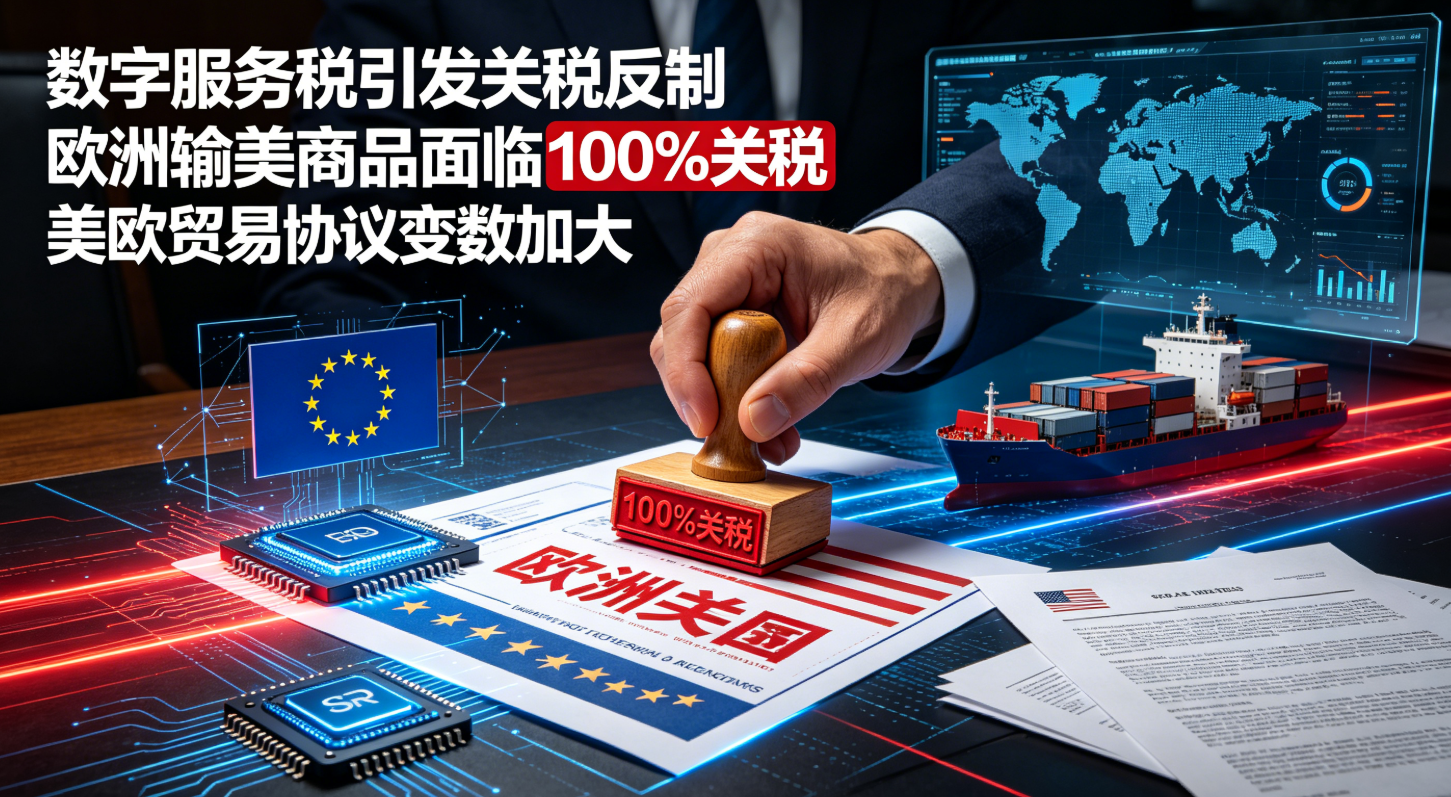
Trump’s 100% Tariff Threat Over Digital Services Taxes: A New Flashpoint in Transatlantic Trade
Keywords: Trump, digital services tax, DST, tariffs, U.S.-EU trade, technology companies, trade policy, European Union, taxation, trade disputes
Introduction
The latest trade warning from U.S. President Donald Trump has once again placed transatlantic economic relations under strain. On Friday, Trump threatened to impose a 100% tariff on imports from any country that levies a digital services tax (DST) on American technology firms. In a social media post, he singled out European countries that he said were preparing to implement such measures, arguing that the tariff would override any existing or future trade agreements.
The announcement marks more than just another tariff threat. It reflects a deeper conflict over how governments should tax value created in the digital economy, who bears the burden of that taxation, and whether trade policy can be used as a weapon against fiscal policy. As economies become increasingly digital and platform-based, the issue of how to tax dominant technology companies has become a major global policy question. For Washington, however, DSTs are viewed not simply as tax reform, but as discriminatory measures aimed largely at American firms such as Meta, Alphabet, and Amazon.
Trump’s warning comes at a sensitive moment, just ahead of a July 4 deadline under a previously announced U.S.-EU trade arrangement. While that deal was expected to cap tariffs on most EU exports to the United States at 15%, digital services taxes were left unresolved. This omission leaves one of the most contentious disputes between Washington and Brussels still very much alive.
A Tariff Threat Designed to Deter DSTs
Trump’s message was explicit: any country imposing a DST on U.S. tech companies would face a 100% tariff on its exports to the United States. He further claimed that the tariff would take precedence over “any and all” trade agreements, whether already signed, approved, or still under negotiation.
The political objective behind the threat is clear. Trump has long argued that digital services taxes unfairly target American technology giants, which dominate the global digital economy. By threatening severe import duties, he is attempting to force foreign governments to reconsider or abandon DST plans before they become law or are fully enforced.
This strategy is not new. During his presidency, Trump repeatedly signaled that he was willing to use tariffs as a tool to retaliate against digital taxation. Last year, he threatened to end all trade negotiations with Canada if Ottawa proceeded with its own version of a DST. Canada later withdrew the measure shortly before it was scheduled to take effect. That episode strengthened the perception that the United States might use its economic leverage to discourage other countries from adopting similar policies.
The message to Europe is therefore consistent with a broader pattern: when tax policy affects U.S. tech companies, Trump appears prepared to respond with trade punishment. The difference now is the scale of the threat. A 100% tariff is extraordinarily severe and would, if implemented, amount to an economic shock for any country dependent on exports to the American market.
Why Digital Services Taxes Keep Expanding
To understand why DSTs remain attractive to governments despite U.S. objections, it is necessary to consider the structural changes in the global economy. Economic activity has increasingly shifted from physical goods to digital services, data-driven business models, and online platforms. Yet traditional tax systems were designed for an older economy, in which value was more closely tied to physical presence, factories, and tangible assets.
Many governments argue that digital companies earn substantial revenues in markets where they have no meaningful physical presence and therefore pay relatively little tax there. DSTs were created as a way to address this gap. Typically, they apply only to the largest multinational technology firms, especially those with dominant market positions and global scale. In practice, this means companies such as Meta, Alphabet, and Amazon are the primary targets.
Supporters of DSTs say the tax is not anti-American, but rather a temporary corrective measure until a broader international tax framework can be agreed upon. They argue that it is unfair for digital giants to generate profits from local users and advertisers while contributing little to the public finances of the countries in which those revenues are earned.
At least a dozen countries have already adopted some form of digital services tax. Others are still considering it, particularly in Europe, where the debate has become especially intense. For many governments, DSTs are also politically appealing because they are easy to explain to voters: large multinational tech firms are seen as profitable, powerful, and under-taxed. In a period of fiscal pressure, that makes them an attractive source of revenue.
The Core Dispute: Tax Sovereignty vs. Trade Pressure
Trump’s threat exposes a fundamental tension between two principles: the right of sovereign states to design their own tax systems, and the use of trade policy to punish measures deemed harmful by another country.
From the perspective of European governments, a DST is a domestic taxation matter. They view it as a legitimate response to the mismatch between the modern digital economy and legacy tax rules. From the U.S. perspective, however, such taxes appear to be discriminatory because they disproportionately affect American firms, many of which are the largest and most profitable in the sector.
This disagreement is not merely technical. It reflects differing philosophies about economic power, fairness, and globalization. The United States has long benefited from the global success of its technology sector. European governments, by contrast, have grown increasingly frustrated that the digital economy’s value creation often escapes taxation in their jurisdictions.
The result is a policy collision. If the United States retaliates with high tariffs, it will effectively be using import duties to influence foreign tax policy. If European governments back down, they may be seen as surrendering tax sovereignty under U.S. pressure. Either outcome carries political costs.
What makes Trump’s latest warning especially notable is the scale and immediacy of the proposed response. A 100% tariff is not a measured negotiating tactic; it is a maximalist deterrent. Its purpose is likely less about precise legal implementation and more about creating enough fear to stop DSTs before they are enacted or expanded.
Legal Uncertainty Surrounding the Tariff Plan
Despite the political force of the threat, a major question remains unanswered: under what legal authority could the president immediately impose such a sweeping tariff on specific countries?
That question matters because Trump’s earlier tariff efforts have already faced serious judicial resistance. The U.S. Supreme Court previously ruled that his “reciprocal tariff” policy was unlawful. That policy would have imposed individualized tariff rates on nearly all trading partners. The Court found that the International Emergency Economic Powers Act did not authorize the administration to impose such broad global tariffs on its own.
After that defeat, Trump signed a new executive order invoking Section 122 of the Trade Act of 1974 to impose a 10% global uniform tariff. But that provision allows tariffs to remain in place for no longer than 150 days unless Congress approves a longer extension.
This legal backdrop makes the new DST threat more complicated than it appears. Even if the administration wishes to act immediately, it may lack a clear statutory basis for a 100% tariff directed at specific nations because of their tax policy choices. Any such move would likely face legal challenges from businesses, trade partners, and perhaps members of Congress.
In practice, the uncertainty around legal authority can be as important as the threat itself. Markets, governments, and corporations all respond not only to what is formally enacted, but also to the possibility that it could happen. Trump’s statement is therefore a form of pressure politics: it seeks to create strategic uncertainty and force others to reconsider their plans before the U.S. system fully tests the legality of the measure.
The Broader Trade and Diplomatic Consequences
If Trump were to follow through on the threat, the consequences would likely extend beyond the tax issue itself. A 100% tariff would be deeply disruptive to global trade flows, especially for countries with strong export ties to the United States. It would also risk escalating a broader confrontation between Washington and its allies.
For the European Union, the timing is especially delicate. The EU and the United States were expected to begin implementing their trade agreement on July 4, with tariffs on most EU goods entering the U.S. capped at 15%. That arrangement was designed to stabilize relations and reduce friction. Yet the exclusion of DSTs from the deal means that the most politically sensitive issue was left unresolved.
This creates a dangerous gap between formal trade cooperation and underlying strategic distrust. If Washington uses tariffs to retaliate against digital tax measures, Brussels could respond with countermeasures or accelerate efforts to build more autonomous tax and industrial policies. The dispute could also complicate broader cooperation on technology governance, data regulation, competition policy, and cybersecurity.
There is also a risk of unintended consequences. Instead of pressuring only governments considering DSTs, such a tariff regime could hurt consumers, importers, and industries far removed from the tech tax debate. A 100% tariff would likely raise costs, disrupt supply chains, and trigger political backlash among U.S. firms and consumers who rely on goods from the targeted countries.
From a geopolitical perspective, the threat reinforces a trend that has become increasingly visible in recent years: trade tools are being used for non-trade purposes. Tariffs are no longer just instruments to balance imports and exports; they are also being deployed as leverage in disputes over taxation, industrial policy, national security, and technological dominance.
Conclusion
Trump’s threat to impose a 100% tariff on imports from countries that adopt digital services taxes represents a sharp escalation in the long-running dispute between the United States and its trading partners over the taxation of the digital economy. It reflects his broader belief that tariffs can be used as a powerful deterrent against policies he considers unfair to American companies.
At the same time, the issue exposes the limits of existing international tax rules. As more economic activity moves online, governments are struggling to determine how and where digital profits should be taxed. For many countries, DSTs are a practical, if imperfect, solution. For the United States, they are a direct challenge to the global position of its technology champions.
Whether Trump’s threat becomes a real policy or remains a bargaining tactic, it has already served a purpose: it has sharpened the stakes of the DST debate and reminded trading partners that tax policy and trade policy are now deeply intertwined. The unresolved question is whether the United States and its allies can build a stable framework for taxing digital business without turning every disagreement into a tariff confrontation.